

The One Question That Transformed My Classroom in a Week
Reading time: 5 minutes
Every teacher dreams of hearing authentic thinking instead of one-word answers. For years, I thought that goal required elaborate lessons or new materials. It turned out all I needed was one simple shift in how I asked questions.
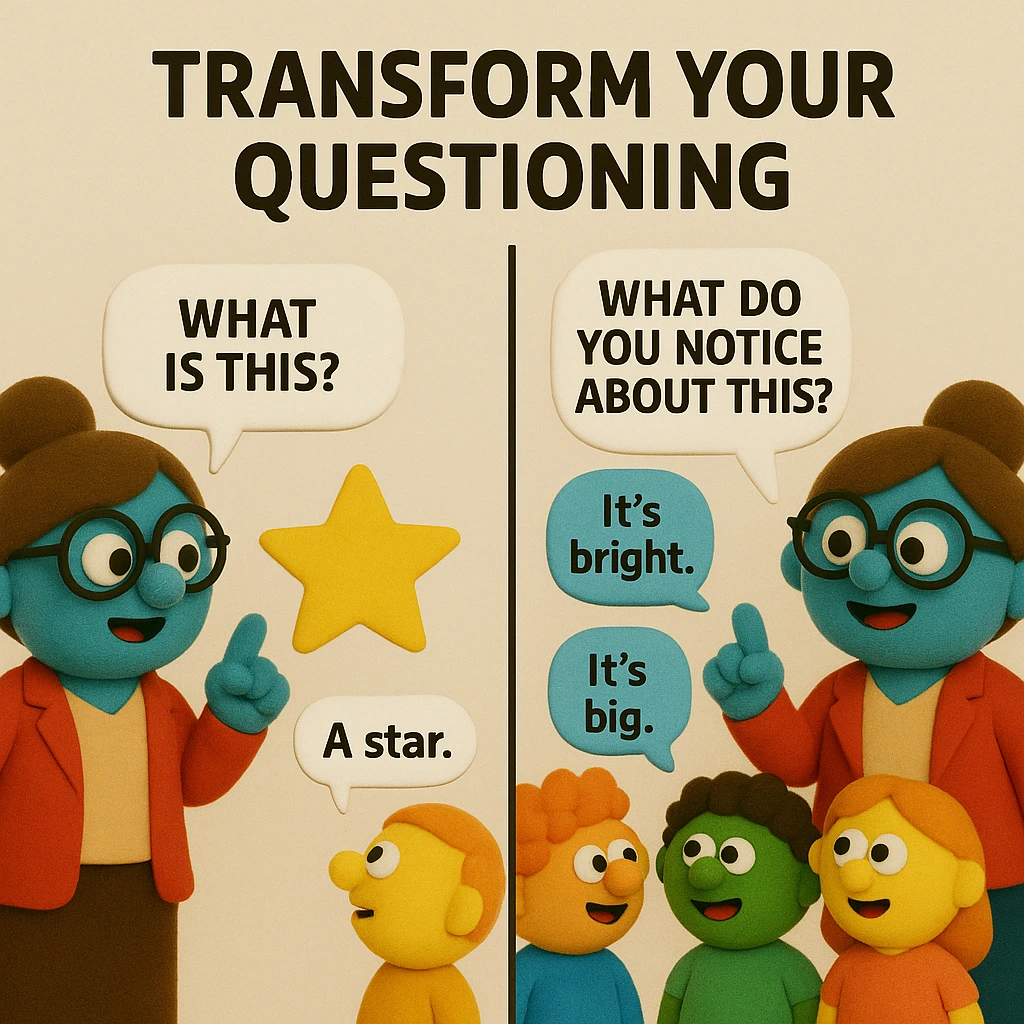
I replaced “What is this?” with “What do you notice about this?”
That tiny change completely altered the way my students interacted with the world around them.
The Power of Observation
The first time I tried it, I showed a group of five-year-olds a simple picture of geometric shapes. Usually, the answers came quickly: “A circle,” “A square,” “A triangle.” This time, I asked, “What do you notice?”
The room grew quiet for a moment, then something remarkable happened.
A child pointed to the triangle and said, “It looks smaller because it’s farther away.”
Another added, “The circle looks like the sun.”
A third child observed, “The square and the triangle make a house.”
Within seconds, the discussion bloomed. Children who usually sat silent began sharing ideas. They weren’t guessing what I wanted to hear—they were exploring what they truly saw.
What Changed
By changing the question, I changed the goal. Closed questions test recall. Open questions invite reasoning, comparison, and imagination.
I started hearing children’s thought processes out loud, and that allowed me to see exactly how they understood concepts.
Conversations lasted three times longer. Students built on one another’s ideas instead of waiting for their turn to give the “right” answer. I watched their confidence grow with every observation they shared.
The Brain Science Behind It
Research in cognitive neuroscience explains why this works. Open-ended questions engage multiple areas of the brain, including those linked to curiosity, emotional regulation, and higher-order thinking. When students make observations, they activate connections between memory, pattern recognition, and problem-solving.
In contrast, simple recall questions limit brain activation to stored information. They confirm knowledge but rarely deepen it.
When we invite children to notice, connect, and reason, we light up the parts of the brain that drive learning motivation.
Follow-Up Prompts That Deepen Thinking
Once you start using open questions, add gentle follow-ups that stretch reasoning even further:
-
“What makes you think that?”
-
“How did you figure that out?”
-
“I wonder what would happen if…?”
-
“Can you show me another way to see it?”
Each of these turns a surface-level observation into a meaningful exploration.
Why It Works Across Ages and Subjects
This approach isn’t limited to early years settings. It works in science, art, literacy, and even secondary classrooms. A simple “What do you notice?” can spark dialogue around a poem, a math pattern, or a piece of artwork.
The technique removes the pressure to perform. Instead of searching for the correct answer, students search for connections. The conversation itself becomes the learning process.
Try It Tomorrow
If you want to test this yourself, start small. Choose one activity tomorrow and replace every closed question with an open one. Keep a notepad nearby and record what students say. You’ll hear richer vocabulary, more reasoning, and creative associations you didn’t expect.
This one question transformed my classroom in a week, not because it changed my students, but because it changed how I listened.
So, teachers: what’s your go-to question that sparks genuine thinking in your classroom?
Thanks for reading!
We love helping teachers make learning creative, hands-on, and fun. If this post inspired you, please share it with a fellow teacher or tag us on social media. It really helps our community grow!
EDU Groove, Stay groovy!