

How 10 Minutes of Routine Can Transform Your Teaching Day
Reading time: 4 minutes
Every teacher knows that transitions can make or break a morning. The moments between arrival, circle time, and the next activity often decide how smoothly the day will go. What if a short, structured routine could reclaim nearly an hour of calm, focused learning time?
Recent studies reveal that classrooms with predictable rhythms experience 42% fewer behavioral disruptions. When young children understand what comes next, their bodies relax and their minds open to new ideas. Predictability nurtures confidence, and confidence fuels curiosity.
Why predictability works
Children are still learning how to manage time, emotions, and impulses. Their developing brains rely on repetition and pattern. By giving them consistency, we build the scaffolding for self-regulation. Structure doesn’t restrict them; it frees them to explore without anxiety.
What worked in my classroom
Here’s the data that reshaped my mornings:
-
Morning visual schedules with simple icons reduced transition time from eight minutes to just two.
-
Songs that signal cleanup time improved compliance by 37% compared to verbal reminders.
-
Consistent goodbye rituals reduced separation anxiety by 28% in preschool classrooms.
These numbers show that structure isn’t just efficient; it creates a classroom where everyone feels safe enough to learn.
Rhythm, not rigidity
Routines don’t need to feel strict or mechanical. Think of them as a steady pulse that keeps your classroom grounded. Small, familiar cues like visual charts, short songs, or repeated phrases become gentle anchors. When the day flows in a predictable rhythm, children stay engaged longer and transitions feel effortless.
The key is to start small. Spend ten minutes establishing a few consistent moments:
-
Add visual cues that help children see the day ahead.
-
Use clear signals for transitions, such as songs, sounds, or gestures.
-
Repeat your opening and closing routines until they feel natural.
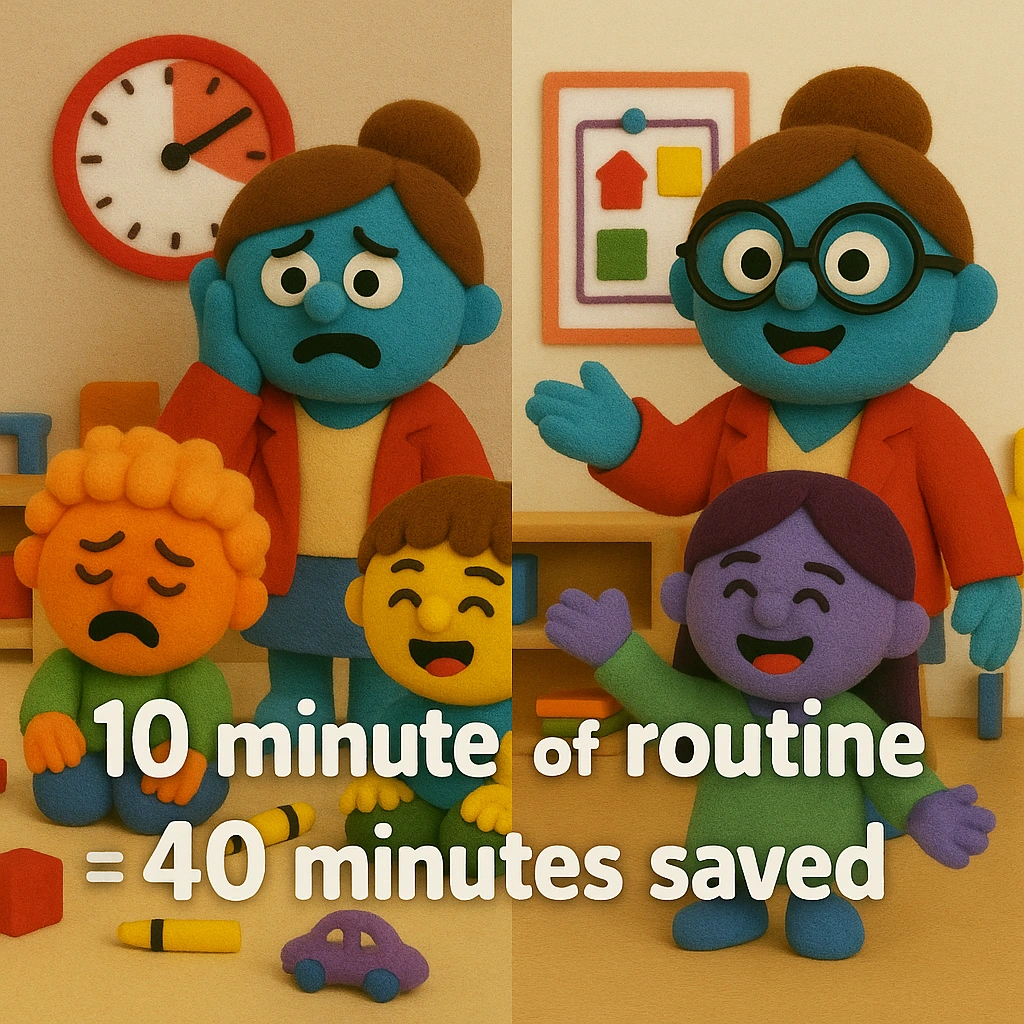
Those ten minutes of preparation can save forty minutes or more later in the day. You’ll spend less time redirecting and more time exploring, discussing, and celebrating learning together.
What science tells us
Executive function skills such as focus, memory, and flexibility develop slowly throughout childhood. Until children can self-regulate, they borrow structure from the adults around them. Our routines act like training wheels that guide independence.
Neuroscience research shows that predictable environments help the brain conserve energy. When students understand what to expect, they stop scanning for uncertainty and start using that energy to think creatively.
A small challenge for tomorrow
Look at your own classroom routine and notice whether any part could feel smoother or more consistent. Maybe you already use picture cards or a tidy-up song. Try adding one more cue. Choose a single moment, perhaps arrival time, and give it structure. Notice how much calmer the room feels when predictability replaces confusion.
A few intentional minutes at the start of the day can reshape everything that follows. The question every teacher faces: do you want to spend your energy managing behavior or nurturing discovery?
Thanks for reading!
We love helping teachers make learning creative, hands-on, and fun. If this post inspired you, please share it with a fellow teacher or tag us on social media. It really helps our community grow!
EDU Groove, Stay groovy!